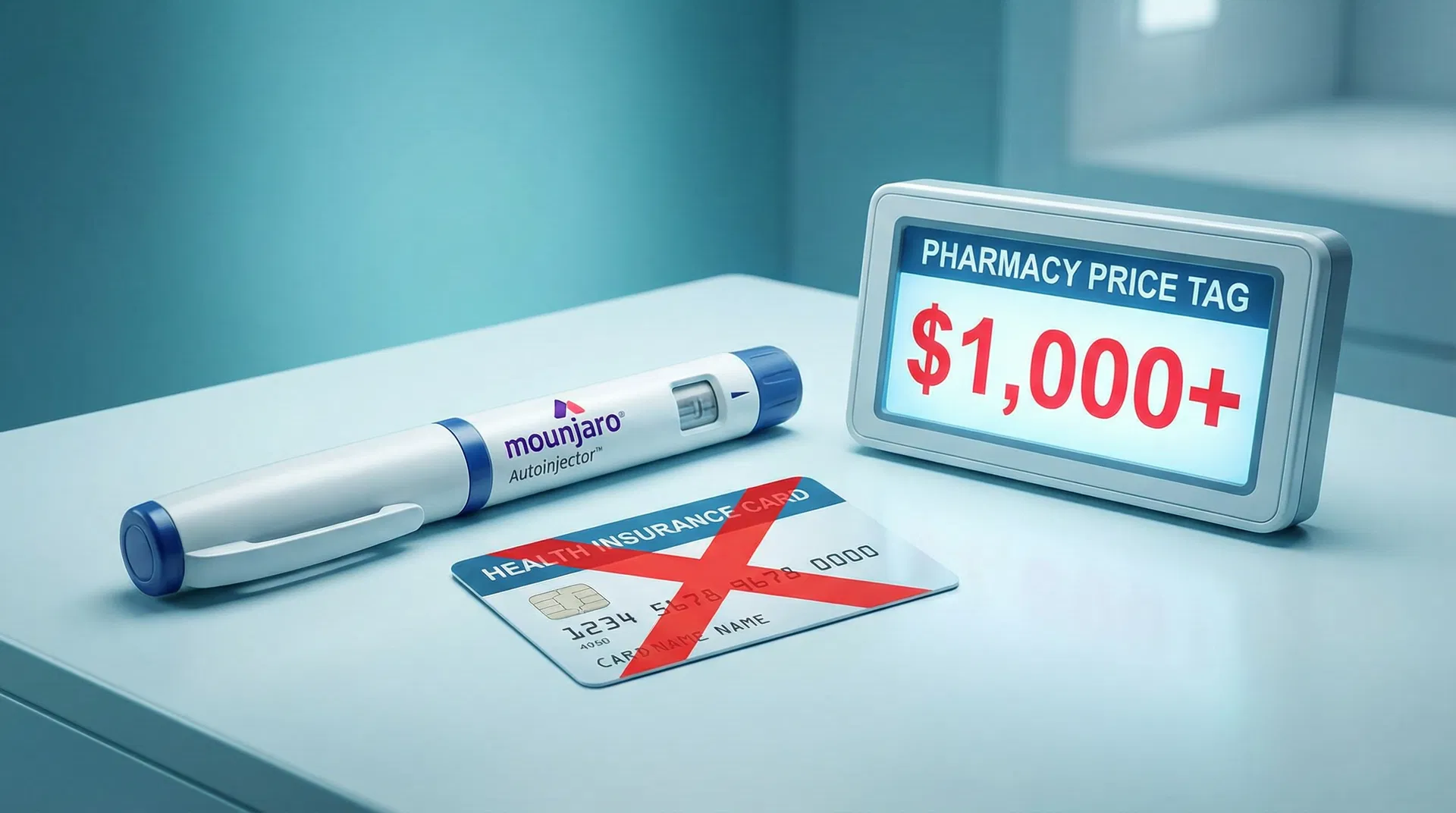
Mounjaro Without Insurance: The Bottom Line
Without insurance, the list price of Mounjaro (tirzepatide) is $1,112.16 per month for all doses (2.5 mg through 15 mg). This is the price you would pay at a retail pharmacy with no insurance and no discount program. However, very few patients actually pay this amount — several programs exist that can reduce your cost substantially.
The most important thing to know: if you have any commercial insurance at all (even if it does not cover Mounjaro), you may be eligible for the Lilly Savings Card, which can reduce your cost to as low as $25/month. If you have no insurance whatsoever, prescription discount services typically bring the price to $499–$600/month, and the Lilly Cares patient assistance program may provide free medication if you meet income requirements.
Mounjaro Prices at Major Pharmacies (Without Insurance, 2026)
Without any discount program, Mounjaro retail prices at major pharmacies are:
| Pharmacy | Mounjaro (any dose) Price/Month |
|---|---|
| CVS | ~$1,112 |
| Walgreens | ~$1,112 |
| Walmart Pharmacy | ~$1,112 |
| Costco Pharmacy | ~$1,090 |
| Kroger Pharmacy | ~$1,112 |
| Rite Aid | ~$1,112 |
| Sam's Club Pharmacy | ~$1,080 |
Prices reflect the wholesale acquisition cost and may vary slightly by location. Costco and Sam's Club often have slightly lower prices due to their membership-based pharmacy model.
Compare Mounjaro prices at pharmacies near you with the free RxGo savings tool →
How to Get Mounjaro for $25/Month: The Lilly Savings Card
The Lilly Savings Card is the most powerful cost-reduction tool available for Mounjaro. Here is exactly how it works:
Who qualifies:
- You have a valid Mounjaro prescription for an approved use (type 2 diabetes)
- You are enrolled in a commercial drug insurance plan (employer-sponsored, ACA marketplace, or individual plan)
- You are not enrolled in Medicare, Medicaid, TRICARE, or any other government-funded healthcare program
- You are a U.S. resident aged 18 or older
What you save:
- With insurance that covers Mounjaro: Pay as little as $25 per month (1-month or 3-month supply)
- With insurance that does not cover Mounjaro: Pay as low as $25 per month (subject to maximum monthly savings limits)
How to enroll: Visit mounjaro.lilly.com/savings-resources to enroll online. You will receive a savings card that you present at the pharmacy counter. The card is accepted at all major retail pharmacies.
Important limitation: The savings card expires on 12/31/2026 and cannot be used by Medicare or Medicaid beneficiaries.
Mounjaro Cost With No Insurance at All
If you have absolutely no insurance coverage, your options are more limited but still meaningful:
Prescription discount services ($499–$600/month): Services like RxGo, GoodRx, and SingleCare negotiate discounted rates with pharmacy networks. For Mounjaro, these services typically bring the price to $499–$600/month depending on the pharmacy and your location. This is significantly less than the $1,112 list price.
Lilly Cares Foundation (potentially free): Eli Lilly's patient assistance program provides free Mounjaro to patients who meet income eligibility requirements. Eligibility is generally based on income below 400% of the federal poverty level and lack of adequate insurance. Applications must be submitted through your prescribing physician. Processing takes 2–4 weeks. Visit lillycares.com for eligibility criteria and application forms.
Consider Zepbound vials instead: If you are using tirzepatide for weight management rather than diabetes, Zepbound single-dose vials through LillyDirect cost $299–$449/month — significantly less than Mounjaro at retail. Discuss with your doctor whether Zepbound is an appropriate alternative for your situation.
Does Insurance Cover Mounjaro?
Mounjaro has better insurance coverage than Zepbound because it is approved for type 2 diabetes — a condition that virtually all commercial insurance plans cover. However, coverage is not universal:
Commercial insurance: Most employer-sponsored and ACA marketplace plans cover Mounjaro for type 2 diabetes, typically at Tier 3 or Tier 4 (specialty drug tier). Prior authorization is almost always required. Your out-of-pocket cost after insurance varies widely — from $25/month with the savings card to $200–$400/month depending on your plan's specialty drug copay.
Medicare Part D: Medicare covers Mounjaro for type 2 diabetes. Under the Inflation Reduction Act, out-of-pocket costs for covered drugs are capped at $2,100 for the full year in 2026. Note that the Lilly Savings Card cannot be used with Medicare.
Medicaid: Coverage varies by state. Some state Medicaid programs cover Mounjaro for diabetes; others require step therapy (trying metformin and other first-line agents first). Contact your state Medicaid office for specific formulary information.
Weight loss only: If you are seeking Mounjaro specifically for weight loss without a diabetes diagnosis, insurance coverage is very unlikely. In this case, Zepbound (the weight-management-approved formulation) is the more appropriate prescription, and LillyDirect vials offer the best cash price.
Prior Authorization for Mounjaro: What to Expect
Most insurance plans that cover Mounjaro require prior authorization (PA). The PA process typically requires your doctor to document:
- Your type 2 diabetes diagnosis (HbA1c level)
- That you have tried and failed at least one first-line medication (usually metformin)
- Your current BMI and weight history
- Any relevant comorbidities
The PA process takes 5–10 business days. If your initial PA is denied, you have the right to appeal. Your doctor can submit a letter of medical necessity, and many appeals are successful. If your appeal is denied, you can request an external review through your state insurance commissioner.
Mounjaro vs. Other Diabetes Medications: Cost Comparison
If cost is a primary concern, it is worth understanding how Mounjaro compares to other diabetes medications:
| Medication | Class | Monthly Cost (Uninsured) | Monthly Cost (With Insurance) |
|---|---|---|---|
| Metformin (generic) | Biguanide | $4–$15 | $0–$10 |
| Ozempic (semaglutide) | GLP-1 RA | ~$1,000 | $25–$100 |
| Mounjaro (tirzepatide) | GIP/GLP-1 RA | $499–$1,112 | $25–$200 |
| Jardiance (empagliflozin) | SGLT2 inhibitor | ~$600 | $30–$100 |
| Trulicity (dulaglutide) | GLP-1 RA | ~$900 | $25–$100 |
Mounjaro is among the most expensive diabetes medications, but its superior efficacy in reducing HbA1c and body weight often makes it cost-effective from a health outcomes perspective. See our drug class cost comparison tool for a full breakdown.
Frequently Asked Questions
Can I get Mounjaro for free? Potentially, through the Lilly Cares Foundation if you meet income eligibility requirements. Visit lillycares.com to check eligibility.
Is there a Mounjaro coupon? The Lilly Savings Card functions as a coupon and is the most effective discount available. Third-party discount services like RxGo and GoodRx also provide coupons that reduce the price at retail pharmacies.
Why is Mounjaro so expensive without insurance? Mounjaro is a biologic injectable medication with no generic equivalent. The high list price reflects manufacturing complexity, R&D costs, and the absence of competition. Generic versions (biosimilars) are not expected until the early 2030s.
Does Mounjaro cost the same at all doses? Yes — Mounjaro is priced identically across all doses (2.5 mg through 15 mg) at $1,112/month list price. This is unusual for injectable medications and means there is no financial incentive to stay at a lower dose.
Save up to 80% on this medication
Use a free RxGo discount card at 67,000+ pharmacies — no sign-up, no insurance needed.
About the Author
James Okafor, RPh, MBA
Registered Pharmacist & Health Economics Writer
James Okafor is a registered pharmacist with over 12 years of experience in retail and clinical pharmacy settings. He holds an MBA with a focus on healthcare management and specializes in translating complex drug pricing, formulary, and insurance coverage topics into clear, actionable guidance for patients. Before joining RxGuide, James worked as a clinical pharmacist at a regional hospital system and as a pharmacy benefits consultant for a national PBM. His writing focuses on cost transparency, generic alternatives, and helping patients navigate the U.S. prescription drug system.
View full profile on our Editorial Team page →Get the RxGo app — free prescription discounts on the go
Works at 67,000+ pharmacies · No membership needed