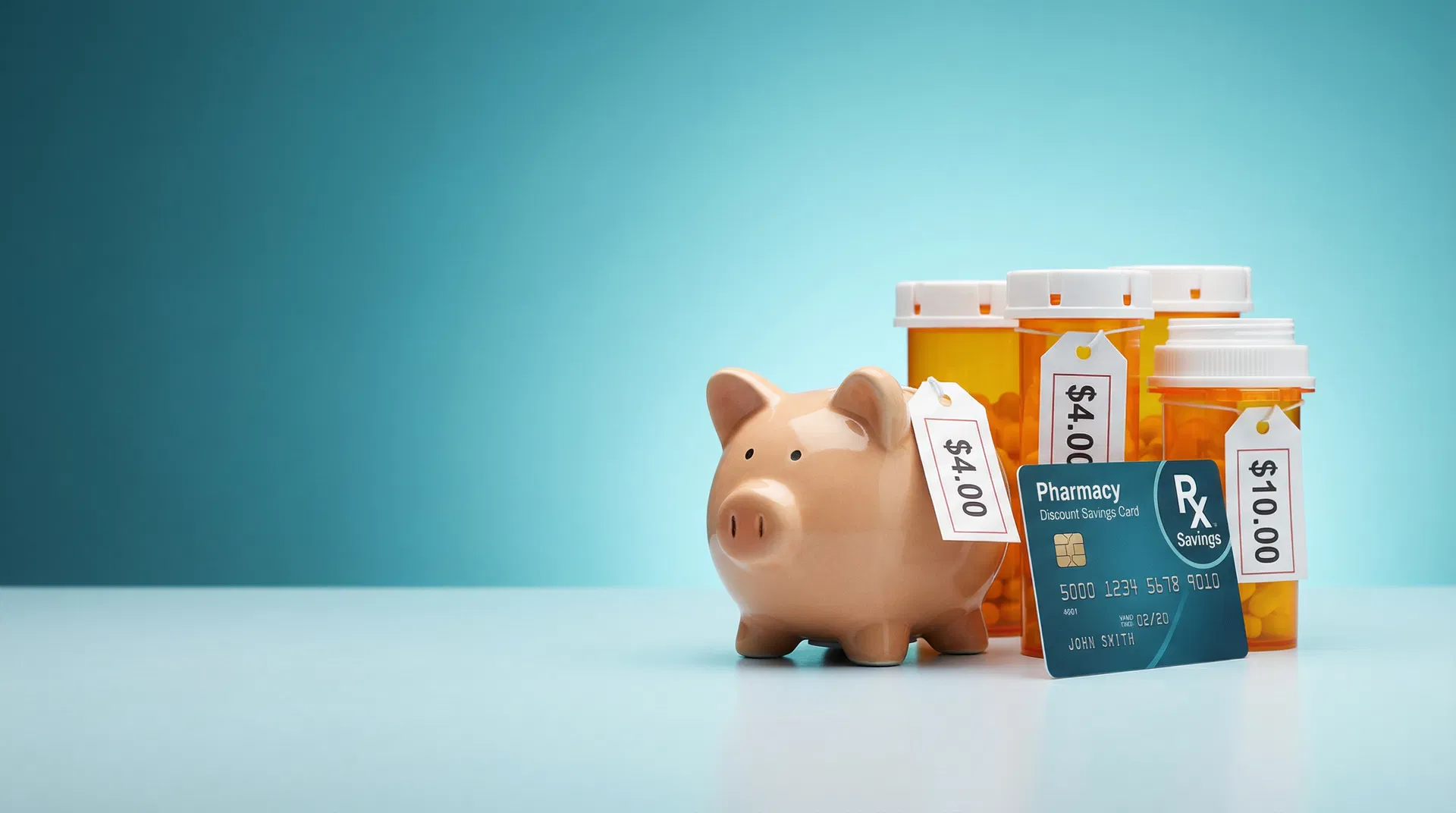
Prescription drug costs in the United States are among the highest in the world. According to the Kaiser Family Foundation, nearly 3 in 10 American adults report not taking their medications as prescribed because of cost — a problem that leads to avoidable hospitalizations and worsening chronic disease. The good news is that a combination of practical strategies can dramatically reduce what you pay at the pharmacy counter, often without changing your medication at all.
This guide walks through nine evidence-based strategies for lowering your prescription costs, from the simplest (asking for a generic) to the most powerful (stacking discount programs). Whether you have insurance, are uninsured, or are on Medicare, at least several of these approaches will apply to your situation.
1. Always Ask for the Generic
The single most effective way to reduce prescription costs is to take a generic medication instead of the brand-name equivalent. Generic drugs contain the same active ingredient, at the same dose and strength, as their brand-name counterparts — the FDA requires bioequivalence before approving any generic. The price difference, however, is dramatic.
Consider atorvastatin (the generic for Lipitor): a 30-day supply costs $4–$25 per month at most pharmacies with a discount card. Brand-name Lipitor, by contrast, can run $200–$400 per month without insurance. Similarly, metformin — the most prescribed diabetes drug in the world — costs just $4–$15 per month as a generic, compared to $80–$150 per month for brand-name Glucophage.
When your doctor writes a prescription, ask specifically: "Is there a generic available, and is it appropriate for my condition?" Most physicians will say yes. If a generic is not available for your exact drug, ask whether a different drug in the same class has a generic. For example, if you are prescribed brand-name Crestor (rosuvastatin), your doctor may be willing to switch you to simvastatin at $4–$20 per month — a statin with a comparable clinical profile and a long generic track record.
2. Use a Free Prescription Discount Card
Prescription discount cards are free programs that negotiate lower prices with pharmacy networks. When you present a discount card at the pharmacy, the pharmacist runs it through the card's network and charges you the negotiated rate — which is often lower than your insurance copay.
The most important thing to know: you can use a discount card even if you have insurance, and you should use whichever is cheaper on any given fill. For generic medications, the discount card price frequently beats the insurance copay.
RxGo is one of the strongest options available. It searches across 10+ discount networks simultaneously, is accepted at 67,000+ pharmacies nationwide (including CVS, Walgreens, Walmart, Costco, Kroger, and thousands of independents), and never requires sign-up or personal information. Unlike some competitors, RxGo does not sell your health data — a meaningful distinction after the FTC fined GoodRx $1.5 million in 2023 for sharing consumer health information with advertising platforms.
To use it: search for your medication at rxguide.com/savings, get your free coupon, and show it at the pharmacy counter. The process takes under two minutes and costs nothing.
3. Compare Prices Across Pharmacies
Prescription prices are not uniform. The same 30-day supply of a generic medication can vary by 300–400% between pharmacies in the same zip code. A 2022 study published in JAMA Internal Medicine found that patients who compared prices before filling a prescription saved an average of $48 per fill on commonly prescribed generics.
Warehouse clubs like Costco and Sam's Club consistently offer the lowest cash prices on generics — often $4–$10 for a 30-day supply — and you do not need a membership to use the pharmacy. Walmart's $4 generic program covers hundreds of medications. Independent pharmacies, which are often overlooked, frequently match or beat chain pharmacy prices, especially for 90-day supplies.
The RxGuide drug cost pages list typical price ranges for over 255 medications, giving you a baseline before you call around. For a side-by-side comparison of all drugs in a class — for example, all statins or all ACE inhibitors — use the drug class cost comparison tool.
4. Get a 90-Day Supply
Filling a 90-day supply instead of a 30-day supply typically reduces the per-pill cost by 20–33%. Most insurance plans and discount programs offer a lower unit price for 90-day fills, and mail-order pharmacies (offered through most major insurers) often add an additional discount on top.
If you take a maintenance medication — a drug you fill every month for a chronic condition like hypertension, diabetes, or high cholesterol — ask your doctor to write a 90-day prescription. For lisinopril (a common blood pressure medication), a 90-day supply with a discount card typically costs $10–$20, compared to $4–$15 for 30 days — a meaningful savings when multiplied across a year.
5. Check Manufacturer Patient Assistance Programs
For brand-name medications with no generic equivalent, pharmaceutical manufacturers often offer Patient Assistance Programs (PAPs) that provide the drug free or at a deeply reduced cost to qualifying patients. Eligibility is typically based on income, insurance status, and diagnosis.
The best starting points for finding PAPs are:
- NeedyMeds (needymeds.org) — the most comprehensive database of PAPs, state programs, and disease-specific foundations
- RxAssist (rxassist.org) — maintained by Volunteers in Health Care, with detailed eligibility criteria
- The manufacturer's own website — most major pharmaceutical companies list their PAPs under "Patient Support" or "Affordability"
For GLP-1 medications like semaglutide (Wegovy) — which can cost $1,200–$1,800 per month without insurance — Novo Nordisk's NovoCare program offers savings cards that can reduce out-of-pocket costs to $0 for commercially insured patients. Similarly, Eli Lilly's Lilly Cares program covers tirzepatide (Mounjaro) for qualifying uninsured patients.
6. Ask About Pill Splitting
For certain medications, pill splitting — cutting a higher-dose tablet in half — can effectively halve your drug costs. This works because many medications are priced similarly regardless of dose: a 40 mg tablet of a statin often costs the same as a 20 mg tablet.
Not all medications are safe to split. Extended-release formulations, enteric-coated tablets, capsules, and some narrow-therapeutic-index drugs should never be split. Always ask your pharmacist before splitting any pill. For medications where splitting is safe — including many statins, ACE inhibitors, and antidepressants — a $15 pill splitter can save hundreds of dollars per year.
7. Review Your Formulary and Switch Tiers
If you have insurance, your plan's formulary (the list of covered drugs) assigns each medication to a cost tier. Tier 1 (generics) has the lowest copay; Tier 3 or 4 (brand-name or specialty drugs) can require 30–50% coinsurance. Requesting a "formulary exception" or asking your doctor to prescribe a Tier 1 or Tier 2 alternative can dramatically reduce your copay.
During Medicare Part D's annual open enrollment (October 15 – December 7), compare plans based on your specific medications using the Medicare Plan Finder tool. Switching plans can save Medicare beneficiaries hundreds to thousands of dollars per year — but only if you compare based on your actual drug list, not just the monthly premium.
8. Use State Pharmaceutical Assistance Programs
Many states operate their own prescription assistance programs for residents who do not qualify for Medicaid but still struggle with drug costs. These programs vary widely by state — some offer direct subsidies, others provide supplemental coverage for Medicare beneficiaries, and some operate as discount card programs.
The National Conference of State Legislatures maintains a current list of state pharmaceutical assistance programs at ncsl.org. Income limits and covered medications vary, but these programs are frequently underutilized by eligible patients.
9. Stack Strategies for Maximum Savings
The most powerful approach is to combine multiple strategies. For a patient taking a brand-name medication with a generic equivalent:
- Ask the doctor to switch to the generic
- Use a free RxGo discount card at the pharmacy
- Compare prices at three nearby pharmacies before filling
- Request a 90-day supply
This combination can reduce a $150/month brand-name prescription to under $15/month for the generic equivalent — a 90% reduction without changing the active ingredient.
For brand-name medications with no generic, stacking a manufacturer savings card with a PAP application and a 90-day mail-order supply can reduce costs by 50–80% for many patients.
The Bottom Line
Prescription drug costs are a genuine barrier to adherence for millions of Americans, but the gap between list price and what you actually pay is often enormous — and closeable with the right tools. Start with the generic question at your next appointment, download a free RxGo discount card, and compare prices before every fill. For most patients taking common medications, these three steps alone can save $500–$2,000 per year.
For detailed cost information on specific medications, use the RxGuide drug cost database — it covers typical price ranges, generic availability, coupon availability, and patient assistance programs for over 255 drugs. For a broader comparison of all drugs in a therapeutic class, the drug class cost comparison pages show side-by-side pricing to help you and your doctor identify the most cost-effective option for your condition.
Save up to 80% on this medication
Use a free RxGo discount card at 67,000+ pharmacies — no sign-up, no insurance needed.
About the Author
James Okafor, RPh, MBA
Registered Pharmacist & Health Economics Writer
James Okafor is a registered pharmacist with over 12 years of experience in retail and clinical pharmacy settings. He holds an MBA with a focus on healthcare management and specializes in translating complex drug pricing, formulary, and insurance coverage topics into clear, actionable guidance for patients. Before joining RxGuide, James worked as a clinical pharmacist at a regional hospital system and as a pharmacy benefits consultant for a national PBM. His writing focuses on cost transparency, generic alternatives, and helping patients navigate the U.S. prescription drug system.
View full profile on our Editorial Team page →Get the RxGo app — free prescription discounts on the go
Works at 67,000+ pharmacies · No membership needed